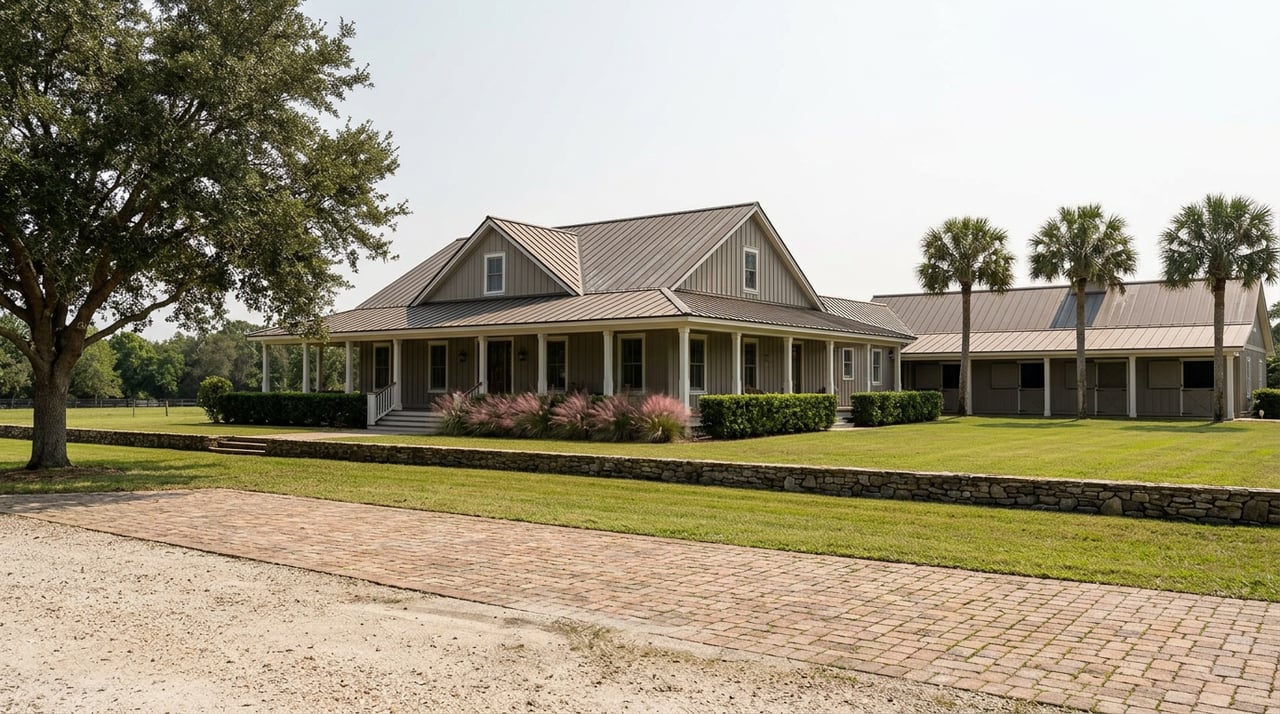
As reported by Your Observer, "The core is intact, but the eastward spread of development threatens to squeeze the authentic, rural life from it."
That is how artist and ecologist Jean Blackburn describes her corner of Old Miakka, a few miles from Myakka City proper, where she has lived on 14 acres of native habitat for more than three decades. She is not talking about a threat that already happened. She is describing a pressure that has been building for years without ever quite arriving, and if you live east of I-75 among the horse farms and citrus groves, you already know exactly what she means.
Here is the part that surprises people who don't live out here: the commercial center of this entire area is two buildings sitting across the highway from each other. That's not a temporary gap waiting for the next strip center. It is, by most evidence available, exactly what the people who live here want.
The Whole Commercial District Fits at One Intersection
Drive State Road 70 through Myakka City and you will pass Myakka City Grocery, a CITGO-branded stop near Ogleby Creek Road that functions as gas station, convenience store, and unofficial town square in one building. Locals go there for fuel, for a cold drink, and for fried chicken that has its own following. It is open early, from 5:30 in the morning, and it stays open into the evening, which tells you something about who relies on it and when.
Across the way sits Silver Star East, the area's one sit-down restaurant. Pickup trucks fill the lot at meal times. Regulars have their booths. The menu runs to country-fried steak, meatloaf, and burgers, and the conversation runs to whatever the land is doing that week. It is not a restaurant built for anyone passing through. It is a restaurant built for the ranchers, farmers, teachers, and horse people who already live within a few miles of it and eat there several times a month.
That's it. That's the commercial district. No second grocery competing for the same customer. No fast-casual chain testing the market. Just a gas station with a kitchen and a diner with regulars, holding down the one intersection that counts.
What Surrounds Two Small Buildings
The absence of a bigger commercial strip isn't for lack of money nearby. This stretch of Sarasota and Manatee County is home to Herrmanns' Royal Lipizzan Ranch, where the famous white performance horses are stabled and trained, and to Dakin Dairy Farms, a working dairy operation that draws visitors for tours and fresh milk. These are not hobby operations. They represent real acreage, real livestock investment, and real household wealth spread across large private parcels.
Put those two facts next to each other and the picture gets more interesting. A community with enough capital to maintain a Lipizzan breeding operation and a full dairy farm has, by any normal pattern of suburban growth, more than enough demand to support a second restaurant or a proper grocery store. It hasn't happened. The people with the resources to build more here are largely the same people who moved out here specifically to get away from more.
Within Reach, If You Already Live Out Here
The radius around that one intersection isn't empty. It's just quiet in a specific, intentional way:
- Crane Park, a small access point on the Myakka River, favored by locals who know it rather than tourists who found it on a map.
- Myakka River State Park, a few miles south, for the canopy walkway and the wide-open prairie sections most Sarasota residents never bother to drive out to see.
- Crowley Museum & Nature Center, 191 acres on Myakka Road with a pioneer cabin, a working sugar cane mill, a half-mile boardwalk, and resident farm animals.
- Dakin Dairy Farms, open for tours and known locally for its ice cream as much as its milk.
- Herrmanns' Royal Lipizzan Ranch, where you can watch the horses train without needing a reason beyond curiosity.
None of these require a membership or an event calendar to enjoy. They are just there, the way a park or a library is just there, if you already know to look.
When the Quiet Calendar Gets Loud
Most of the year, Crowley Museum & Nature Center runs on its normal rhythm, open Thursday through Sunday for anyone who wants pioneer history and a walk through the wetlands. But in late January and early February, it hosts the Myakka River Rendezvous, a living history event now in its fifth year, and these are the days when the quiet part of the calendar gets loud.
The 2026 Rendezvous ran its public days on January 31, February 1, and February 7, with historic campers and reenactors on-site from January 25 through February 8. Visitors got blacksmithing demonstrations, archery, a recreated Native Village, live music, and vendors selling handmade goods, all spread across the center's 191 acres. It is the kind of event that pulls people from Bradenton and Sarasota who would otherwise never make the drive out State Road 70, and on those public days it makes the area's population density look almost normal.
As of this month, Crowley hasn't posted dates for the next Rendezvous. The museum's own site says fall 2026 and winter 2027 dates are still to be announced. If the last five years are a guide, the announcement will land sometime this fall, with the event itself falling in that same late-January window. Worth checking back on if you plan around it the way a lot of your neighbors already do.
Two Names, Two Counties
One point of confusion worth clearing up, since it trips up even people who have lived here a while: Myakka City and Old Miakka are not the same place, despite how often they get used interchangeably. Myakka City is the unincorporated community along State Road 70 in Manatee County, home to the grocery and the diner described above. Old Miakka is a separate, older settlement a few miles away, in Sarasota County, closer to where Jean Blackburn keeps her 14 acres. The spelling difference, Myakka versus Miakka, was never accidental. Federal naming authorities settled it decades ago specifically to keep the two places distinct on the map.
It's a small distinction, but it matters if you're trying to picture where anything actually sits relative to your own address. The horse country east of I-75 isn't one undifferentiated stretch of pasture. It's several small, historically distinct communities that happen to share a highway and a general sense of what they'd rather not become.
Why It Stays This Way
None of this reads like a market waiting to be filled. It reads like a community that has had chances to grow a real commercial strip and passed on most of them. The Lipizzan ranch and the dairy farm prove there's money here. The one grocery store and one diner prove that money isn't chasing convenience. And Blackburn's line about the core staying intact against the pressure of eastward development sounds less like a complaint and more like a description of policy, even if no ordinance ever wrote it down.
If you live out here, you already know which booth is yours at Silver Star East and which pump at Myakka City Grocery has the shortest line. You don't need a guide to tell you where to eat tonight. But it's worth naming what you're actually protecting every time you choose the one diner over driving into town for something with more options. It's not an accident that this place stayed small. It's the whole point.
If you're weighing a move to the equestrian communities east of I-75, or thinking about what a property out here is really worth once you understand how the area lives day to day, the team at Sheldon, Gettel & Dahl knows this stretch of Sarasota and Manatee County from the ground up. Search Homes for Sale to see what's currently available in horse country.