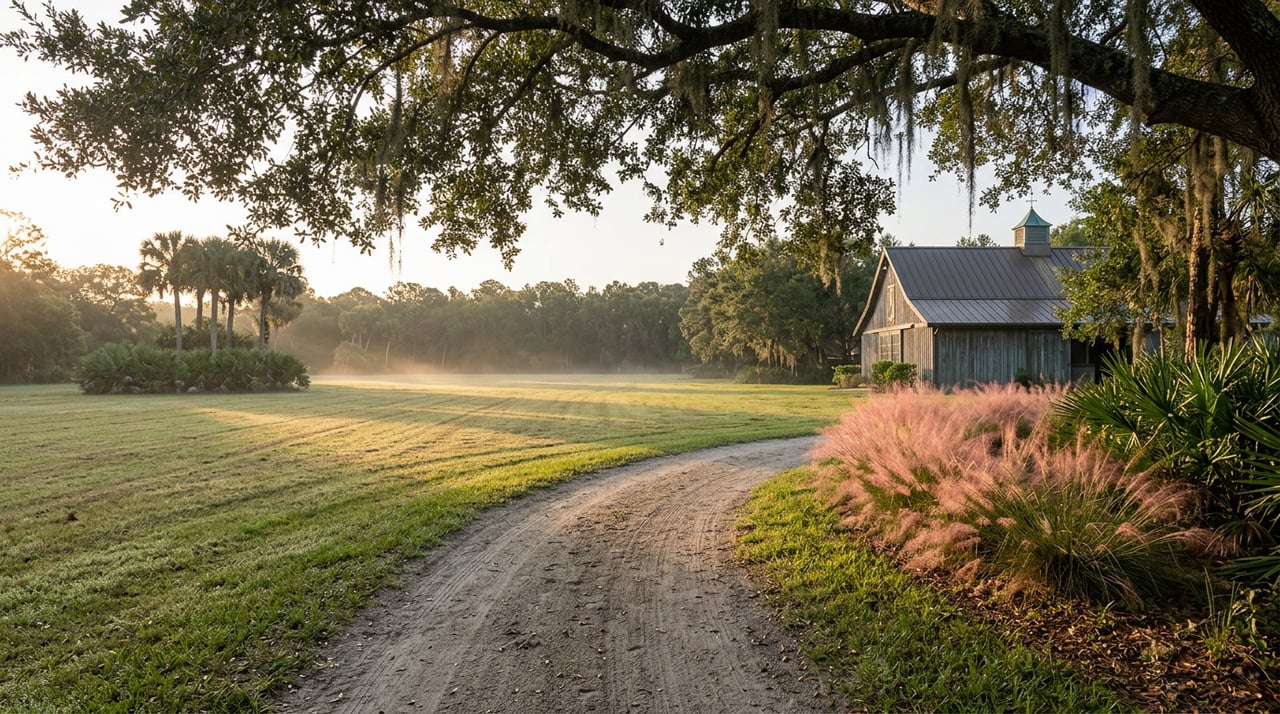
Right now, in the middle of an August afternoon, the cross-country course at TerraNova Equestrian Center sits empty. No braids, no golf carts, no line at the show office. If you ride out from Panther Ridge or Myakka Valley Ranches this week, you will likely have the trail to yourself, minus the heat, which is its own kind of company in a Sarasota summer.
That emptiness is not a lull between nothing. It is the first half of a two-part year that most people who move into this corridor never quite map out before they get here. For roughly half the year, the equestrian communities east of I-75 belong almost entirely to the people who live in them. Then, sometime in November, the calendar flips, and this same stretch of Myakka City and eastern Manatee County becomes one of the more closely watched patches of ground in American competitive riding, with tens of thousands of visitors moving through it by spring.
The Trail Season Nobody Markets
This is the season locals actually get to keep. The barns at TerraNova are quiet enough that the cross-country course, closed to spectators during show weeks, is open for hacking the rest of the year. Riders based nearby use it to condition horses on footing that's engineered with irrigation and drainage most private properties can't match.
The bigger draw for daily riding, though, is what does not require a show entry at all. Myakka Valley Ranches is built around a fact that shapes how people actually spend their mornings there: it borders Myakka River State Park directly, so a horse can walk out of the pasture and onto more than 37,000 acres of state land without ever touching a trailer. The park is open daily from 8 a.m. until sunset, and the terrain shifts from wetland to prairie to oak hammock inside a single loop, which is part of why longtime riders describe it as the most unfiltered version of old Florida still reachable on horseback.
Panther Ridge takes a different approach. Its nine residential enclaves share more than 15 miles of private trail, laid out so a rider can cover real distance without leaving the community's own boundary. It is the version of trail access built for people who want the ride without the drive.
For anyone willing to go a bit further afield, the riding options widen:
- Myakka River Trail Rides, a local outfit in Myakka City, guides visitors and residents through more than 40 acres of oak-shaded trail. Co-owner Attila came to the ranch by way of Hungary and, alongside leading rides, raises Akhal-Teke horses, a rare breed with roots in the ancient Karakum Desert.
- Carlton Reserve in Venice offers county-maintained trails through pine flatwoods and wetlands, with a reasonable drive from the eastern corridor.
- Myakkahatchee Creek Environmental Park in North Port is smaller and less known, without rental horses, but open to anyone who trailers in their own.
None of this requires a ticket or a season pass. It is simply what is available right now, while the show grounds sit dormant.
The Switch Flips in November
That dormancy ends on a predictable schedule. TerraNova's marquee event, known simply as The Event at TerraNova, has become the closing fixture of the U.S. eventing season each fall, drawing entries from Starter level all the way up to the international CCI4*-L, with a CCI4*-S division that now serves as a qualifier for the US Equestrian Open of Eventing. In November 2024, the field included 247 riders, five Olympians among them, competing across TerraNova's six all-weather arenas and a cross-country course built with the same drainage system that keeps it rideable in the off months.
General admission and parking are free, which is easy to overlook given the level of competition on display. Spectators are welcome on Saturdays and Sundays during show weeks, and families tend to gravitate toward Tiny Town, a tech-free play area near the pavilion that stays open for the length of the show. The barns come with permanent stall fans and an on-site feed and tack store, TerraNova Feed and Fence, details that matter more to the competitors than the crowd but that signal how seriously the venue is built.
From that November event forward, TerraNova's weekend show schedule tends to carry through the winter and into early spring, with hunter-jumper and dressage weekends stacked most Saturdays and Sundays. The corridor that was empty in August fills with trailers, RVs, and out-of-state plates within a matter of weeks.
A Season Already on the Calendar, Before the Tickets Exist
The other anchor of the winter calendar sits a short drive west in Lakewood Ranch, and it is less about competition than about community. It has already locked its dates for the coming year even though tickets have not gone on sale yet. The Sarasota Polo Club has confirmed its next season will run from December 20, 2026 through April 15, 2027. Tickets go live this fall, but the dates themselves are public now, which means anyone in the corridor can plan around them months before a wider audience even knows the season is starting.
Sunday Polo has been the club's signature ritual for decades, with matches typically starting at 1 p.m. and gates opening at 10, plus occasional Thursday Sunset Polo Happy Hours scattered through the season. In recent seasons, children 12 and under have gotten in free with general admission tailgating, and the club draws an estimated 50,000 spectators across a typical season on its 170 acres of Bermuda grass fields.
What makes the club different from TerraNova's imported, internationally ranked circuit is where it came from. The land was originally a 28,000-acre timber ranch settled in 1922, and the cowboys working it started playing informal polo in their off hours, using quarter horses and stock saddles instead of anything resembling proper equipment.
One rule from those early games has never been retired: the first rider to fall off their horse buys the team's beer. It's still observed today, more than a century after it started as a joke among ranch hands.
The club became the first development inside Lakewood Ranch in 1991, which means the polo season now sitting on next year's calendar traces directly back to a tradition that predates the master-planned community around it by nearly seventy years.
Why the Order of the Calendar Matters
Most descriptions of this corridor treat it as one continuous lifestyle: horses, acreage, trails, done. What that flattens is the fact that the equestrian communities east of I-75 actually run on two distinct rhythms that barely overlap.
From roughly May through October, the corridor is quiet, hot, and entirely local. The trails at Myakka River State Park and inside Panther Ridge belong to the people who live there, with no competing traffic from show entries or polo tailgaters. Then, starting with TerraNova's November event and running through the Sarasota Polo Club's mid-April close, the same ground becomes a genuine destination, watched by an international field on one side and tens of thousands of local spectators on the other.
Neither season is better. But knowing which one you're standing in changes what the corridor actually feels like day to day, and right now, in late August, residents are in the last stretch of the quiet half before the switch flips again.
If you're weighing a move into Sarasota's horse country, or you already call one of these communities home and want a clearer read on how the seasons here actually work, the team at Sheldon, Gettel & Dahl spends enough time in this corridor to know it beyond the listing sheet. Search Homes for Sale when you're ready to see what's available east of I-75.